Hurricane Season Starts in Your Gutters, Not on the Weather Channel
August 29, 2026
Every June, Floridians stock water, test generators, and photograph the fridge for the insurance folder. Almost nobody looks in their gutters — and the gutters are the part of the house that meets the storm first.
Update, September 2026: multiple national outlets, citing NOAA's own tracking, now confirm this is the slowest start to Atlantic hurricane season in 112 years — no hurricane had formed by September 21, the latest start date since 1914, and only two full seasons in the entire 1851-present record (1907 and 1914) have ever gone without a single hurricane. That's genuinely good news, but it isn't a reason to skip the gutter check: the season runs through November 30, quiet-start years have still produced sudden late-season storms (Wilma made Florida landfall in October), and a quiet start doesn't undo a summer's worth of debris already sitting in your gutters.
Here's what the first hour of a real storm does to a clogged system. A Florida thunderstorm can drop two inches of rain in an hour; a hurricane band, more. Every foot of your roof sheds that water into a channel that might be four inches wide — and if that channel is holding a summer's worth of oak catkins, palm debris, and shingle grit, the water doesn't slow down politely. It goes over the back edge, straight down your walls, behind the fascia board, and into the soffit. The stain on the ceiling shows up weeks later; the rot started the night of the storm.
The other exit is worse: water pouring over the front edge lands in a trench line against your slab. Repeat that through a wet season and you get washed-out landscaping, settling pavers, and the kind of moisture reading against the foundation that home inspectors write paragraphs about.
The 20-minute check anyone can do: After the next hard rain, walk the outside of the house and look for four things — water sheeting over the gutter edge anywhere, downspouts trickling when they should be gushing, sagging runs pulling off the fascia line, and mud lines or mulch craters under the eaves. Any one of those means the system is already failing quietly. You don't need a ladder to see any of it.
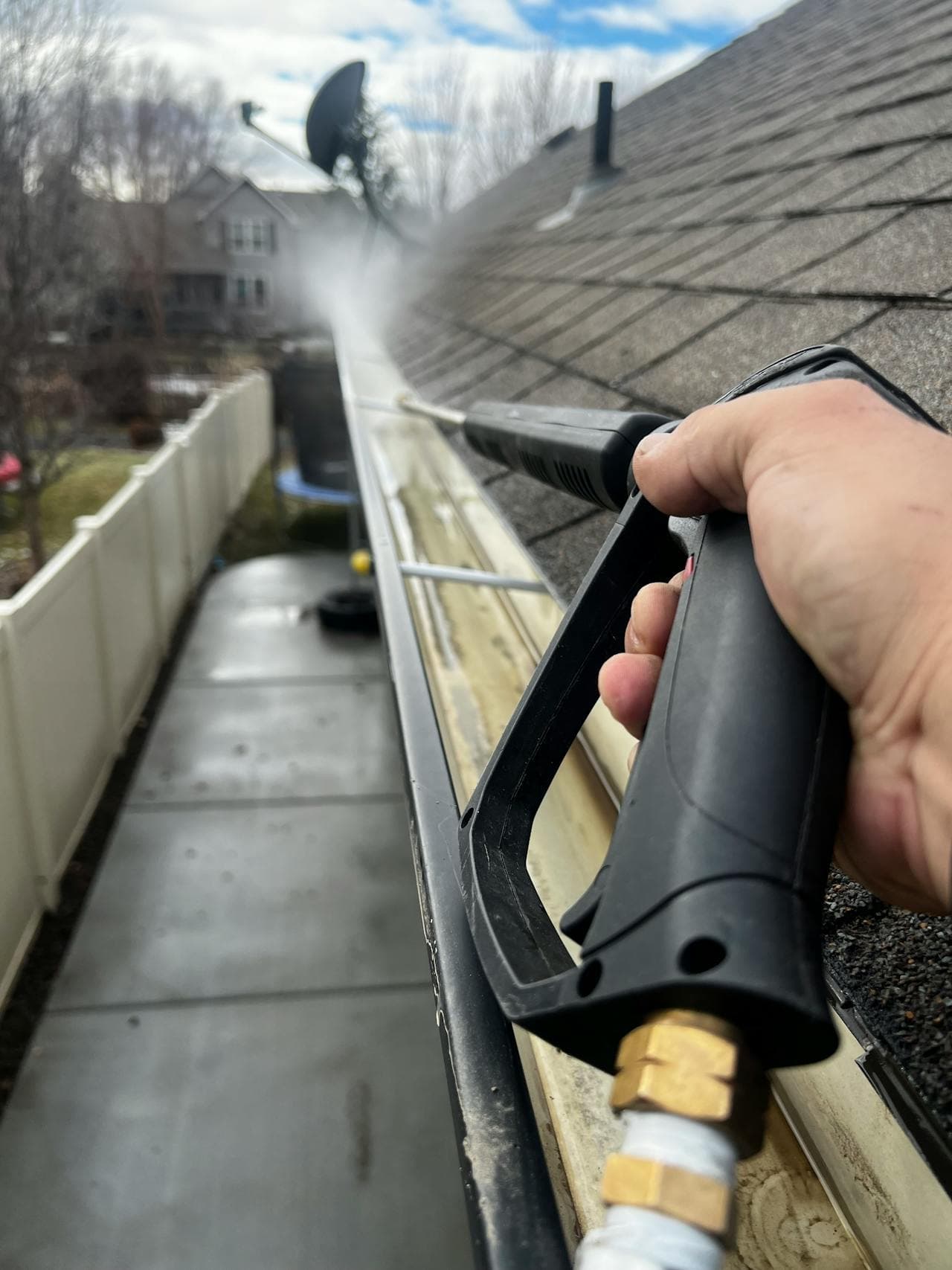
Why we clean by hand instead of blasting: a leaf blower on a gutter run scatters the debris across your roof and lanai and leaves the downspouts — the actual failure point — untouched. Our crews scoop the runs by hand, bag the debris, then flush every downspout with water until it flows full-bore. While we're up there, we check fasteners and fascia and photograph anything that needs attention, because a $12 bracket now beats a fascia repair in November.
Timing, honestly: the smart calendar is a clean-out in April or May — before the season — and again in late fall after the oaks and lovebugs are done. Homes under heavy tree cover or right on the coast often need a third pass. If you have gutter guards, you're not exempt: Florida's fine debris (shingle grit, pollen, seed pods) still gets through, and guards need to come off and go back on properly to clear it — our gutter cost guide explains how that changes the job.
The rest of the storm-prep walk-around: gutters are the piece we handle, but they're one stop on a longer list. While you're outside checking them, it's worth glancing at a few items outside our lane too — overhanging tree limbs that could come down on the roof (a tree-service question), a pool or spa that can fill with runoff and debris (a pool-service question), and gaps or openings storm debris can expose around the foundation or roofline (a pest-control question). We stick to windows, soft washing, and gutters, but a full pre-storm pass usually touches all four.
A gutter cleaning is one of the cheapest lines on a storm-prep list, and it's the only one that protects the house while you sleep. Get your range in 60 seconds with the instant estimate — and if a named storm is already on the map, call sooner rather than later. Every year the week before landfall books out first.
Ready for a spotless property?
Get a free, no-obligation estimate — backed by our Spotless Promise — free re-clean within 72 hours.
Get My Free Estimate